


Self-Alignment: Learning the Rhythm
Blog 2 of 4: Self-Alignment Series
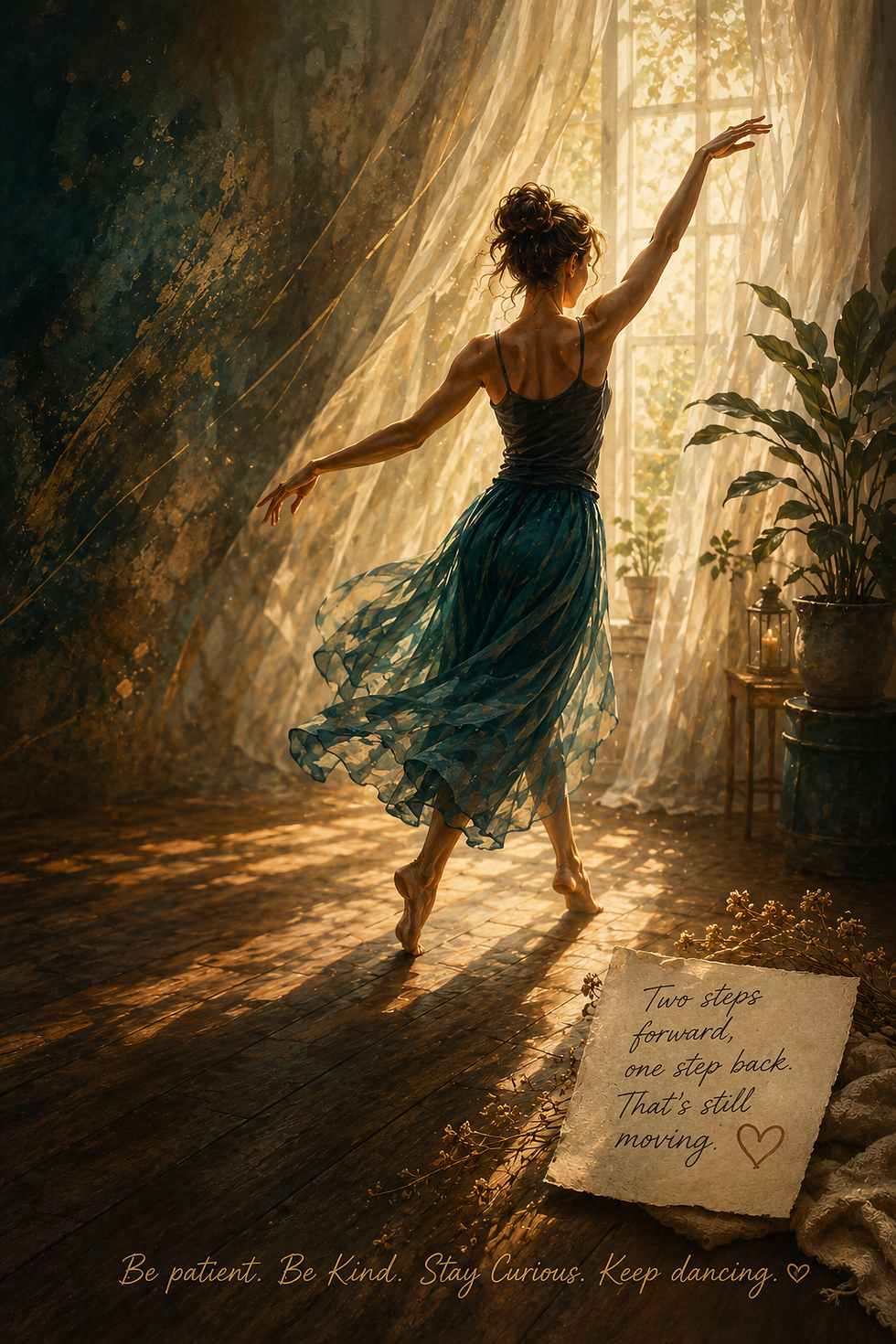
“Life is the dancer and you are the dance.” — Eckhart Tolle
Progress has a funny way of making us want more progress. Something begins to work, we feel the difference, and suddenly we are ready to take on the world. We have more energy, a little confidence and proof that the changes we're making might actually be taking us somewhere. Instead of allowing ourselves to enjoy that feeling, we start wondering what else we could do. If this much feels good, surely a little more would feel even better.
This is often where something that was working becomes harder to maintain. We add another day, another expectation, another task or another rule before the first change has had time to settle into our lives. At first, it can feel like momentum. We're motivated and moving, so why wouldn't we keep building? Then life gets busy, our energy changes or we simply can't maintain everything we've added, and the progress that once felt encouraging begins to feel like something we're falling behind on.
The frustrating part is that we may have been doing just fine before we added anything at all.
When Progress Becomes Pressure
There is nothing wrong with wanting to improve. It feels good to discover that something is working and imagine where it might lead. The difficulty comes when we begin treating every bit of progress as an invitation to immediately do more. We barely give ourselves time to experience one change before deciding what the next one should be.
Eventually, we can make what was working too hard to maintain. Something we enjoyed becomes another responsibility. Something that gave us energy begins taking more than it gives. We push ourselves because we believe we're building on our progress, only to discover that we have moved too quickly and now we're tired, overwhelmed or no longer interested in doing any of it.
Sometimes we can even hurt ourselves by asking too much too soon. We understand this when we're learning something physical. We wouldn't expect our bodies to immediately handle more weight, greater distance or harder movements simply because the first few attempts went well. We give our muscles time to strengthen, we rest when they need rest, and we gradually discover what we're capable of. Yet we don't always offer the rest of our lives that same patience.
When things become difficult, it is easy to assume we need more discipline. We tell ourselves we should be able to keep up because we were the ones who decided to do more in the first place. What we don't always question is whether we needed to add more so quickly. The problem may not be our ability to continue. We may simply have rushed the rhythm.
Two Steps Forward, One Step Back
Progress is much more like a dance than a straight line. We move forward a couple of steps, take one back, turn slightly, find our footing and move again. Sometimes we miss the beat completely. None of those movements tell us very much on their own because the dance only makes sense when we allow ourselves to experience the whole thing.
Yet we have a habit of judging ourselves by individual steps. A productive day means we're doing well, while a difficult one makes us question whether anything is working. A week with visible results feels successful, while a quieter week can leave us wondering what happened. We become so focused on measuring each movement that we lose our sense of the rhythm carrying us through all of them.
When we stop judging every individual step and experience the dance as a whole, we're still travelling across the floor. That step backward didn't erase the two that came before it. The day we rested didn't cancel the days we showed up. The week when very little seemed to happen may have been the week something finally became easier to maintain. Progress doesn't have to continually announce itself for it to be happening.
This is where we can give ourselves a little more room. Instead of immediately reacting to every difficult day, we can stay curious about what is unfolding. We can notice how something feels over time rather than deciding what it means in the moment. Sometimes the adjustment we need isn't another action at all. It is simply allowing ourselves to find the rhythm before we change the dance.
When Too Many Ideas Enter the Room
Once we're moving, it is amazing how quickly we begin seeing other possibilities. We think of another way to do something, hear about what is working for someone else or wonder whether changing one more thing might make everything even better. A new idea can be exactly what we need. It can help us see beyond the plan we originally created and find a simpler way forward. But new ideas can also become noise.
We can spend so much time thinking about what else we could do that we stop experiencing what we're already doing. We adjust something before we know whether it needed adjusting. We rearrange our time to fit in another priority, then rearrange something else to accommodate that change. Before long, we're working harder to maintain the life we're trying to improve.
There is always going to be another possibility. We could do more, learn more, change more, organize things differently or find another way. The presence of another option doesn't automatically mean the one we have chosen is wrong. Sometimes thinking outside the box leads us somewhere useful, and sometimes the most useful realization is that we don't need another box.
This is where enough becomes something we have to feel rather than calculate. If something is working, we can allow it to work. We don't have to squeeze every possible result from it or immediately decide what comes next. Improvement can happen naturally as we learn more about what we need.
Letting Life Into the Plan
Of course, we aren't the only ones moving. Life keeps moving around us too. The week we finally settle into a rhythm might also be the week work gets busier, someone we care about needs more of our time, an unexpected invitation arrives, or we simply wake up one morning without the energy we thought we'd have. None of that means the plan was wrong. It means the plan has finally met the life it was supposed to work within.
This can be where we put unnecessary pressure on ourselves to keep everything going exactly as planned. We don't want to lose the progress we've made, so we try to squeeze everything in anyway. But flexibility doesn't have to mean giving something up, just as changing the plan doesn't mean we've changed the direction. Sometimes we give something less attention for a few days because something else needs us more, and then we find our way back to it.
Balance isn't keeping everything perfectly in place. Some weeks will lean heavily in one direction and others will lean somewhere else. What matters is that we remain part of the decision rather than expecting ourselves to somehow give everything the same amount of time, energy and attention. We can respond to the life that is actually happening without losing sight of the life we're trying to create.
This is part of learning the rhythm too. We aren't gripping the original plan and demanding that life cooperate with it, nor are we throwing everything away the moment life interrupts us. We are staying connected to the direction while allowing the way we get there to change.
Giving Ourselves Enough Time to Know
There is another reason not to rush the process. We need enough time to discover whether we actually want to keep doing what we've started.
Everything unfamiliar has an awkward stage. We don't know the steps yet, we have to think about what we're doing, and sometimes it feels harder simply because it hasn't become natural. If we judge something too quickly, we may walk away before we've had enough experience to know whether it could become part of our lives.
But staying with something long enough to know also gives us permission to reach a different conclusion. We may discover that we don't enjoy it. It may work perfectly well and still not work for us. We may realize that the result matters but the way we've been trying to reach it doesn't, or that something we thought we wanted doesn't feel the same once we're actually living it.
Sometimes we're still learning the steps.
Sometimes it simply isn't our dance.
We don't have to know the difference immediately. We can give ourselves enough time to find out without turning that time into another test we have to pass. We are gathering information through living, noticing what happens and allowing our experience to tell us what the plan on paper never could.
Allowing Progress to Happen
Maybe one of the hardest things about progress is allowing it to happen at its own pace. We are so accustomed to looking for the next step that continuing with what is already working can feel like we're not doing enough. But there are times when continuing is exactly what allows the change to become part of us rather than something we're constantly trying to maintain.
The next action doesn't always need to be decided in advance. It can emerge from what we're learning. We notice that something has become easier, that we have more capacity or that we're genuinely ready for something more. Then we add, change or expand because it makes sense, not because we believe progress should always be getting bigger.
We can still be ambitious. We can still be curious about what is ahead and willing to change direction when something new opens in front of us. Moving at a pace we can live with doesn't make the destination less meaningful. It gives us a better chance of still wanting to be on the journey when we get there.
Self-alignment isn't asking us to perfect the dance. It asks us to stay present enough to feel its rhythm. We pay attention to what is happening, question what genuinely needs questioning, choose with the information we have and adjust when the movement calls for it. Sometimes that means taking another step forward, sometimes it means easing back, and sometimes it means realizing we want to dance in an entirely different direction.
We don't need to judge every movement while we're making it. We need enough patience to let the steps become a dance and enough freedom to discover whether it is ours.
Because when we stop judging every individual step and experience the dance as a whole, we're still travelling across the floor.
Love, Light, Much Gratitude ♥️
Pamela
Your Compass. Your Voice. Your Way Home
If you'd like to delve deeper, I invite you to connect with me.
About the Author
Pamela is a certified Reiki Master/Teacher and Soul Coach Practitioner®. As an Astrologer, she is dedicated to supporting individuals on their healing journeys. Since her spiritual awakening began in 2019, Pamela has focused her efforts on helping clients quiet their mental turmoil, deepen self-awareness, and reconnect with their inner guidance. Through writing, guided meditations, and energy healing services, she provides practical tools for personal transformation and emotional clarity.


Comments